

Mortgage Rates Are Great But Can You Qualify?
By Lisa Scontras
It’s a good news, bad news scenario.
The combination of low home prices and mortgage interest rates make buying a home today more affordable than ever. But in order to take advantage of these extraordinary market conditions, prospective buyers need to be on a very sound financial footing in order to get approved for a loan.
Joy Cabildo, senior vice president of the residential real estate division at First Hawaiian Bank, says consumers looking to qualify for a new mortgage are learning that paying down existing debt is also one of the best ways to convince lenders to approve their loan.
“The GSE’s, government sponsored enterprises, like Fannie Mae and Freddie Mac, continue to squeeze their lending guidelines down making it harder and harder to qualify,” she says. “For example, they now cap their debt-to-income ratio at 45 percent. Last year it was 55 percent.”
On the heals of the worst financial crisis in decades, the conservative swing in lending practices are strict, but not unreasonable.
Consumers can estimate their debt-to-income ratio by adding up all their recurring monthly debt and then dividing that total by their gross monthly income. The lower the number the better, meaning there is plenty of income to pay on the debt owed. Higher numbers make lenders uneasy since their risk associated with lending you money is greater.
“Consumer debt across the board is down since the start of the recession, with non-mortgage consumer debt falling more than 5 percent since 2008, according to the Fed,” says Frank Nothaft, Freddie Mac vice president and chief economist. “And now we’re also seeing a very large share of borrowers reduce their mortgage debt when they refinance.”
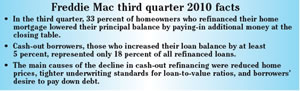
In fact, national figures show that in the third quarter of 2010, 33 percent of homeowners who refinanced their home mortgage lowered their principal balance by paying-in additional money at the closing table.
In Hawaii, Cabildo says insufficient home values are one of the roadblocks to refinancing. Bringing in additional cash at closing is a way to increase your equity to meet the loan-to-value requirements.
“The maximum loan-to-value for a refinance is 80 percent,” says Cabildo. “If you want to take cash out, the LTV is reduced to 75 percent.”
Ideally, this means that if a home’s value is $400,000, the maximum loan amount would be $320,000 – $300,000 if you want to take cash out. A lower LTV means less risk to the lender and a better mortgage interest rate for the borrower.
In addition to the lower debt and LTV ratios, tighter guidelines also include increased requirements when documenting income.
“What has changed in the past three years is that everything needs to be proven and verified, says Cabildo. “There are no more ‘Trust-me loans.'”
It is recommended that borrowers be prepared to fully document all their finances at the time of application, including tax returns with all the schedules, pay stubs, W-2s, bank statements, and any other documentation showing assets and income sources, especially if you’re self employed.
“Self employed borrowers have had it especially rough since the tightening,” says Cabildo. “Anyone other than a salaried employee with lots of equity may have issues.”
Since the idea behind refinancing is to save money, consumers are taking advantage of low interest rates to bring down the monthly payment. Acceptable terms depend on the cost of the refinance and how long it will take to recoup that cost.
For borrowers interested in refinancing who have already paid on a 30-year mortgage for 10 or 15 years, converting to a 15-year mortgage might be advantageous and won’t prolong the mortgage payoff any longer than the original loan. On the other hand, for younger homeowners, spreading out the payments over 30 years is a good way to keep payments low.
Despite underwriting issues in mortgage lending, if you have good credit, a job and steady income, you will find there is plenty of mortgage credit to be extended at good rates. For well-qualified buyers, scoring low rates are an excellent reason to buy or refinance sooner rather than later. And for those who might have some credit issues, First Hawaiian Bank has an additional supply of credit available through loans it doesn’t need to sell to Freddie Mac or Fannie Mae.
“At First Hawaiian Bank, we have the liquidity to portfolio loans and do Make Sense Lending so we are not constrained by the credit markets,” Cabildo says.
See More Listings