

Investors Swap Out Investments With A 1031
 By Lisa Scontras
Two years after financial and credit markets collapsed setting off a world-wide economic crisis, investors are coming up with creative ways for rebuilding their portfolios and getting their investments back on track.
Investors are taking advantage of current market conditions – and a convenient IRS tax code – to upgrade their real estate portfolios while avoiding costly capital gains taxes.
“Successful real estate investors don’t wait for the market to change, they jump on opportunities the current market brings,” says Dan Tabori, executive vice president of business operations at Prudential Locations. “It’s a perfect opportunity to rebuild your portfolio – swap out of properties that aren’t producing enough income.”
The 1031 tax exchange is a vehicle used to move real estate holdings around that allows an investor to sell one property and reinvest it in another property while sidestepping any payment of capital gains taxes. For an investor struggling with increased vacancies or cash flow problems, conditions are ideal for re-evaluating your investment strategy and initiating a 1031 exchange.
The beauty of exchanging properties in this way is that it works in so many common scenarios as a practical cure.
Increased vacancies and cash flow problems are great reasons to consider upgrading your real estate portfolio. If you own a property where rentals are slower than average or you’d like to trade up to something closer to town, the 1031 exchange will allow you to do that.
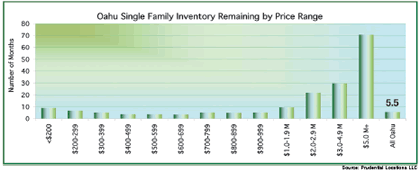
“Since a majority of income-producing properties are studio-, 1-bedroom and 2-bedroom rental condominiums, they are in the price range of the first-time home buyers,” adds Tabori. “Inventories are relatively low in these price points and the pace of sales indicate that it’s a healthy segment of the market.”
But more than a tax strategy, investors use the 1031 exchange to accommodate their long-term investment plans. For example, it may make sense to sell a 1-bedroom apartment in Salt Lake to buy a better 1-bedroom in Waikiki – that maybe has higher monthly rents or better potential for long-term appreciation.
“Maybe you have two smaller units and want to sell both of them to buy one unit in Kakaako,” offers Tabori. “Many times, investors are thinking along the lines of setting up their estate. Maybe they have three children or grandchildren and only two properties and want to sell the two condos to buy three, making it easier to leave each child a property. It really just depends on the needs of the client.”
Tabori points out that because owners of investments property are often well-qualified financially, that now they can take advantage of historically low interest rates that have traditionally not been offered to investors.
“Depending on the property being purchased, we have seen excellent financing options that make the exchange even more attractive and improves the investor’s position and cash flow on day one,” he says.
By exchanging into another investment property rather than selling, investors can also gain further protection from tax exposure, by depreciation their property over the time they own it.
Whether it’s closer to the ocean, closer to town or in a more renter friendly neighborhood, investors are opting to trade in their rentals for a replacement property, allowing them to leverage money that would have otherwise gone to pay taxes.
It might just be the next great investment.
See More Listings