
Senior Living Options – Early Planning is Key!

Hawaii is ranked #1 in the U.S. in having the most multi-generational families living under the same roof. We are raised in a culture where we are expected to take care of one another – especially our elders. As our parents age, family members pitch-in to provide support and care. What many families don’t expect is the high cost of long-term care services as our parents’ health and mobility needs change and require a higher level of care.
The year 2030 marks a pivotal demographic turning point in U.S. history, according to the U.S. Census Bureau. The aging baby boomers, 65 years of age plus are projected to outnumber children under the age of 18 for the first time in U.S. history. The U.S. government projects that 70% of people age 65 plus will need some form of long term care services in their lifetime. This expected exponential growth in our aging population coupled with the rising costs of long-term care, translates to what is anticipated to be a heavy financial burden on individuals, families, government programs and health care providers.

Many Americans are unprepared when it comes to long-term care planning. Many underestimate the costs and mistakenly expect Medicare to fully cover expenses. However, it is clearly stated on Medicare’s website (Medicare.gov), “You pay 100% for non-covered services, including most long-term care.”
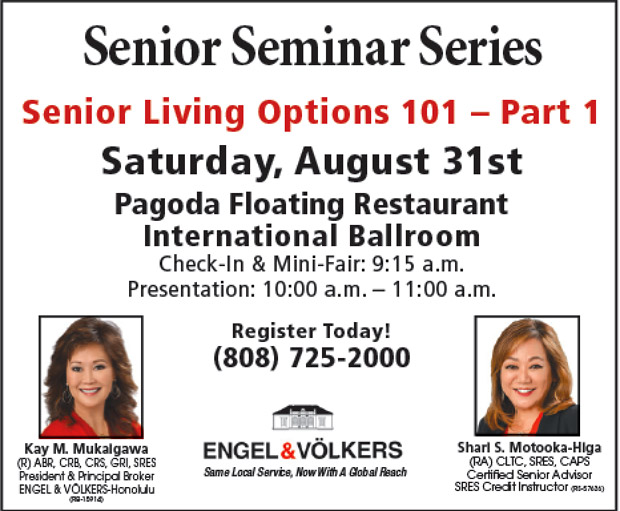
Shari Motooka-Higa, Vice President and Certified Senior Advisor with Engel & Völkers Honolulu, shares that there is a false sense of security and misunderstanding that health insurance covers long-term care costs. Unfortunately, many families discover that they are left to pay for long-term care services out-of-pocket, often burning through their lifetime savings. When all assets are depleted, families end up applying for Medicaid, which is a Federal and State government assistance program. Medicaid is projected to account for 40% of the national spending by the year 2030.
Most boomers have not included long-term care into their retirement plan, which could result in major financial issues down the road. One of the most important aspects of your estate plan is to create a long-term care plan. When it comes to planning how you live out your golden years, you want to be in control and able to make your own decisions. A comprehensive plan is vital because the likelihood of needing long-term health care and the associated cost for services is often greater than what most people are prepared to cover.
According to Kay Mukaigawa, President and Principal Broker, Engel & Völkers Honolulu, when designing your long term care plan, it is equally as important to consider not just the type of care you receive but where you may want to receive your care. Today, there are many options available depending on your needs and budget. Kay suggests to explore the alternative options such as downsizing to a smaller, single level home and incorporating universal home design features which would support aging in place.
Today, there are also more senior living options available than ever before. Finding the right fit will depend on your personal preferences, your financial ability, and specific medical needs. Planning where to live for the next chapter in your life is a major decision. Take the time to do your research and talk to professional advisors.
The key is to plan today to protect your tomorrow! The ideal time to do your research is long before you need it as the repercussions of waiting may limit your options. By taking the steps to map out your course of action, you ensure that your options, care and lifestyle are tailored to your personal needs and while being more financially prepared.