

What’s Up (Or Down) In Your Neighborhood
 By Lisa Scontras
Analyzing real estate prices from month-to-month and year-to-year commonly means comparing the all-Oahu median sales price. And while the overall median price of a home does illustrate big-picture trends, it may not tell you anything about what is happening in your neighborhood, on your street or in your building.
When making real estate decisions, it’s important for buyers and sellers to get the complete picture of the industry, which means taking a close look at the little picture – your neighborhood.
“What we’re seeing is that each neighborhood behaves differently, and is influenced by different market conditions,” says Bill Chee, president and CEO at Prudential Locations.
In 2010, prices in 32 percent of the neighborhoods on Oahu were down, while the majority, 68 percent, saw prices increase.
“None of our competitors analyze the data like we do,” says Chee. “We do because we believe that before you make a purchase or make a sale, you should know what market conditions are behind the numbers.”
Dr. Michael Sklarz, president and CEO of the Honolulu-based real estate consulting firm Collateral Analytics, has been analyzing real estate market trends in Hawaii for more than 26 years.
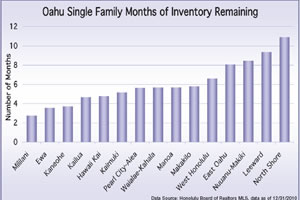
Sklarz tracks Months of Remaining Inventory – how long active listings will last at the current rate of sales. In 2010, on a neighborhood-by-neighborhood level, there was anywhere from 3.8 months of inventory remaining (very low, indicating a strong market) to 10 months (a somewhat slower-paced market).
“Even on a relatively small island, there are big variations of supply and demand conditions,” says Sklarz.
To find out what those differences are, he digs into the nuts and bolts of the neighborhood markets to determine exactly who is buying and selling, and how rapidly sales are occurring. Sklarz will even delve into the extent of sub-prime lending in each neighborhood and how leveraged the homeowners there are.
For example, he found that down payment amounts vary from neighborhood to neighborhood. Typically affluent buyers in markets such as Hawaii Kai will make a bigger down payment when they buy a home. Believe it or not, this practice lends stability to the neighborhood by giving the homeowner more equity headroom. The down payment becomes particularly important in a depreciating market. If a buyer has little or nothing down and the market drops 10 percent, suddenly the owner is upside down on their mortgage and, if forced to sell, in trouble.
Markets where owners are more highly leveraged are then more susceptible to small dips in prices – sometimes leading to more foreclosures.
Buyers and sellers in all communities are going to make better decisions when they know what is happening in their neighborhood.
“The philosophy at Prudential Location is to empower its agents to empower their clients with information – the complete picture, with information about the health of the economy, as well as what is going on in your particular neighborhood,” Chee says. “We know our clients make smarter decisions this way, and are more successful. We believe because we have seen it happen over and over again, that real estate is the best way to build long-term wealth. Once you have the knowledge, then you will see the opportunities for yourself.”
See More Listings